

Your first 90 days with AI, in order
An AI implementation plan for a small business fits in 90 days: a month of drafting, a month building one automation, and a month deciding what comes next.
Choose the Mini AI Assessment when you book the free 30-minute Discovery Call. We’ll identify one time sink and show you the tool or next step most likely to fix it. No pitch, no obligation.
Practical, no-hype notes on AI and automation for Cork and Munster businesses: what it actually costs, which jobs to hand over first, and how to use these tools without getting burned. Plain English, written for busy owners.

An AI implementation plan for a small business fits in 90 days: a month of drafting, a month building one automation, and a month deciding what comes next.
AI for quantity surveyors in Ireland pays for itself on the paperwork around the numbers: tender documents, valuation write-ups and the letters in between.
Disclose AI to customers when they’re talking to it, when it made something they’d assume a person made, or when it decides something about them.
AI training for staff can fit into one hour if you teach four things: what to use it for, how to ask, what never goes in, and how to check what comes out.
When AI makes a mistake in front of a customer, treat it as your own mistake: correct it quickly and in person, then put a human check where it slipped through.
To make AI writing sound human, give the tool a few samples of your own writing to copy, then delete the stock phrases and tidy patterns that give it away.
Who owns AI-generated content? For an Irish business, you can usually use it as your own, but the legal protection around it is thinner than for work a person wrote.
Part of AI by sector: what AI actually does, industry by industry.
AI for architects and engineering practices in Ireland pays off on the writing around the design: specifications, planning responses, fee proposals and minutes.
Ask a small practice where the week goes and the drawings are rarely the answer. The answer is the documents that travel with the drawings. The outline spec that has to become a full one. The response to a further information request, due in a window that always seems to land in the same month as two tenders. The fee proposal for a client who wants three options by Friday.
Four things: it drafts, it summarises, it searches your own documents, and it reminds. It does not design, it does not check a calculation, and it does not certify anything. Your professional judgement and your indemnity cover sit where they always sat, with you.
The sales pitch in this sector drifts towards generative design and rendering. For a five-person practice in Cork, though, the hours are lost in Word and Outlook, not massing studies.
Partly, and the part you can automate is the dull part. A specification is mostly reuse: clauses carried over from the last similar job, edited for this site, this client and this build-up. The skill is knowing what to change; the labour is finding the right previous version and changing it consistently.
Where a drafting tool helps:
The hard limit is references. A general AI tool will happily produce a standard reference that looks right and is wrong: a superseded number, a standard that does not say what the clause claims, a discontinued product. In a contract document that is worse than a gap, because nobody goes looking for it. Every standard, product and performance figure gets checked against the source by someone qualified to check it. Treat the draft the way you would a graduate’s first attempt: useful, and unchecked.
This is the most time-sensitive writing in the practice, and much of it follows a pattern. A response to a further information request takes each numbered item in turn and answers it, pointing to the revised drawing or report.
Two jobs worth handing over:
What it should not do is interpret planning policy for you. It will quote a development plan objective with total confidence and get the number or the wording wrong. If a policy matters to the argument, someone opens the plan and reads it.
A fee proposal is a scope, a stage breakdown, assumptions, exclusions and a number. The number is yours. Everything around it is largely last month’s document with new names, which is where a template plus a drafting tool saves time.
Build one solid proposal structure, describe the new project in a few lines, and get a first draft with the scope and stages filled in from your own standard wording. Exclusions are where practices get burned later, so ask the tool which of your standard ones might apply and why. It will often catch the one you forgot at six in the evening.
The rest is ordinary practice admin:
The contractor end of the same projects is in the note on AI for builders and construction firms, and the cost side in AI for quantity surveyors.
Most practices have the answer somewhere already. What was agreed with the fire consultant on the last school job, which detail the Assigned Certifier queried, what the client signed off at stage 2. It is in an email, a minutes file or a PDF, and finding it takes longer than it should.
A tool set up over your own project files lets you ask in normal language and get pointed at the document. It should search your files, not the open internet, and show you the source so you read the real thing.
Client information deserves the same care here as anywhere. Drawings of someone’s home or a commercial client’s confidential plans never go into a free consumer account. The general argument is in the note on putting client data into AI tools. This is general information, not legal advice.
You are. A spec clause or a planning response goes out under the practice’s name, whichever tool drafted it. So somebody signs off every document that leaves the office, anything checkable (a standard, a clause number, a policy objective) is checked against the source, and when a mistake gets through you fix it, tell the client and change the step that let it pass. The note on what to do when AI gets it wrong covers that in more detail. If you are unsure how your indemnity insurer views AI-assisted work, ask your broker.
If you would rather someone sat with you and worked out the order for your own office, that is what the AI Assessment is for: a fixed-fee look at how the week actually runs, ending with a plain plan, the first thing to set up and a follow-up call to go through it, credited in full against a build if you go ahead.
The assessment is credited in full if you go on to a build, and if I can’t find you five hours a week you pay nothing. See how it works.
AI for insurance brokers in Ireland earns its keep on the admin wrapped around the advice: chasing renewals before they lapse, writing up why one quote was recommended over another, and keeping a file that stands up to a compliance review.
AI for charities in Ireland earns its place on the admin: funding applications drafted, donor thank-yous written properly, and the reporting pack assembled without losing a weekend to it.
AI for childcare providers belongs on the paperwork, not the children: parent messages drafted, enrolment enquiries answered, and the policy folder made findable again.
AI for farming in Ireland earns its keep in the office, not the yard: scheme paperwork drafted, farm records made findable, and correspondence answered before ten at night.
AI for plumbers and electricians earns its keep on the paperwork, not the pipework: quotes drafted from a voice note, follow-ups chased, cert records kept findable.
AI features in existing software are the cheapest AI you will ever use, and your Microsoft or Google plan, CRM and accounts package probably include some already.
An AI policy for a small business fits on one page: which tools staff may use, what never gets pasted in, who checks the output, and who to ask.
AI for driving instructors is mostly a diary problem: cancellations, rescheduling, reminders and the messages you end up answering at the kerb between lessons.
AI for salon booking helps most with three jobs: no-show reminders, rebooking prompts, and the phone that rings while your hands are in someone’s hair.
AI helps an Irish veterinary practice most with the admin: vaccination recalls, appointment reminders and the phone that rings in the middle of a consult.
An AI agent for business is software you give an outcome rather than steps, which works out the steps and uses your systems to finish the job itself.
AI for recruitment agencies in Ireland earns its keep on job specs, candidate summaries and the follow-up chase, while a person keeps the shortlist.
AI helps an Irish pharmacy most with the counter admin: chasing repeat scripts, routine phone questions and the paperwork behind the dispensary.
Setting up AI automation takes an afternoon for a drafting habit, one to three weeks for one automation and one to three months for several joined up.
AI for a Cork gym or fitness studio pays off on the admin around the coaching: enquiry replies, class reminders, lapsed members and the weekly posts.
No business is too small for AI: what decides it is whether one dull task repeats every week, and a sole trader has that as surely as a firm of forty.
An AI course teaches you to use the tools; an AI consultant works out which jobs in your business are worth handing to them, and sets those up.
Real AI automation examples for a small business are mostly dull: a quote drafted from site notes, a sorted inbox, an invoice chased on day seven.
AI for a construction small business belongs in the paperwork: drafting quotes, writing up site records and chasing the payments that stall a job.
AI for estate agents in Ireland earns its keep on the admin around a sale: listing copy, enquiry replies, viewing notes and vendor updates.
To write AI prompts that actually work, give the tool four things: who it is for, the real material, the format you want and one example of good.
AI vs hiring in a small business comes down to one test: automate the work that repeats to a pattern, and hire when the job needs judgement or presence.
AI email management works best for a small business when it sorts and drafts while you decide what actually gets sent, which keeps replies personal.
AI helps a Cork clinic draft appointment reminders, aftercare sheets and FAQ replies in minutes, as long as patient records stay out of consumer chatbots.
AI for a small retail business pays off on the writing around the shop floor: product descriptions, customer emails, social posts and stock updates.
AI for solicitors in Ireland is useful for first drafts, summaries and file admin, as long as a solicitor checks every output and client confidentiality is settled before anything is pasted in.
The EU AI Act applies lightly to most Irish small businesses: if you use ordinary AI tools, your duties are honesty with customers and training your staff, not paperwork.
An AI receptionist for a small business answers calls, texts and web chats when nobody is free, then either resolves the enquiry or books it into your calendar.
The best AI tools for Irish small businesses in 2026 are a short list matched to the job: a chatbot for drafting, a notetaker for meetings and a booking tool that reads your calendar.
To choose an AI consultant in Ireland, ask for a fixed fee, a guarantee tied to a real outcome, named tools before you pay, and a straight answer on your data.
Is AI actually worth it for a small business? Usually yes, but only for the dull, repeatable parts of the week, not as a blanket upgrade to everything you do.
AI automation cost in Ireland splits into three tiers, a monthly subscription, a one-off build or ongoing support, and the tier decides the price. The honest answer to “how much?” still starts with “it depends”, and nobody enjoys hearing that.
An AI assessment for a small business is a paid, 60-minute look at how your week actually runs, ending with a written plan, a four-day quick start and a follow-up call.
Usually, yes: client data in AI tools stays GDPR-safe on a business tier with training off, names kept out of prompts and a person checking the output.
Tasks a small business can automate this month include reminders, invoice chasing, review requests, email drafts and a weekly report that builds itself.
AI for hospitality in Cork means letting a tool draft the review replies, guest emails, rotas and supplier orders, while you keep the final say on every one. Picture a Saturday in a busy spot off Oliver Plunkett Street. The floor is full, the kitchen is flat out, and somewhere between the lunch rush and the evening covers a pile of small jobs is stacking up. Three reviews to reply to. A supplier waiting on an order confirmation. Two enquiries in the inbox asking the same thing about the set menu. None of it is hard. All of it eats the hour you should be spending on the floor, or at home.
AI for accountants and bookkeepers in Ireland saves real time on drafting, summarising and chasing, but the figures still need a human eye. If you run a small practice in Cork or anywhere across Munster, you know the shape of the week already. Client work in the day, then the admin tail after: the email you owe three people, the meeting notes you meant to write up, the reminder about a VAT deadline you keep forgetting to send. That tail is where AI earns its keep: on the writing wrapped around the numbers, rather than the numbers themselves.
AI for tradespeople in Ireland can draft your quotes, chase unpaid invoices and turn van voice notes into job records, so the admin stops eating your evenings. Picture the usual. It’s half nine at night. The van’s back, the kids are down, and you’re at the kitchen table with a cold cup of tea, working out a quote you should have sent on Tuesday. You’re grand on the tools. Nobody ever told you the job came with two hours of admin a night.
You often don’t need an AI consultant: low-risk drafting and summarising is fine to do yourself, and help pays once client data or real hours are at stake. This is an honest guide for owners in Cork and Munster on when DIY works and when help pays. I’d rather you spend nothing and get a small win than hand me money for something you could have set up over a wet Sunday afternoon.
To know if your business is actually making money, you need job-by-job profit in one view that updates itself and gives you a straight answer on a Monday. The vans are moving, the diary is full, and the honest answer to “what did we make last month?” can still be a shrug. That shrug is not a sign anyone is doing a bad job. It means the numbers live in too many places to see at once.
ChatGPT vs Claude for business: for most small Irish firms both are good enough, so the right one is whichever your team will actually open every day.
One team I worked with started every week the same way. Someone exported four files, cleaned them by hand, pasted them into a template, and sent it round by ten. Two hours gone before the real work even started.
There is a lot of noise about AI taking jobs. On the ground, in ordinary businesses, that is not what I see happening.
Made for a multinational technology company in my role as a Data Analyst. Created with artificial data.

Awarded to <0.01% of published vizzes by Tableau's editorial team.

Hover, filter and switch tabs.
Featured by Tableau's official account on LinkedIn.
Christmas is a major time for sales around the world, and making the most of the holiday rush can be a bit challenging. In this task, I helped a multinational technology company analyse Christmas data to uncover insights into customer behaviors during the festive season. The dataset provided includes anonymized Christmas sales data across various product categories, customer demographics, and marketing campaigns.
Here are my key takeaways
Children (ages 1–11) contributed nearly 40% of total Christmas sales, with Smartphones and in-store shopping being their top preferences.
The top 5 best-selling products, all for children, declined by up to 15% over four years — highlighting changing consumer trends.
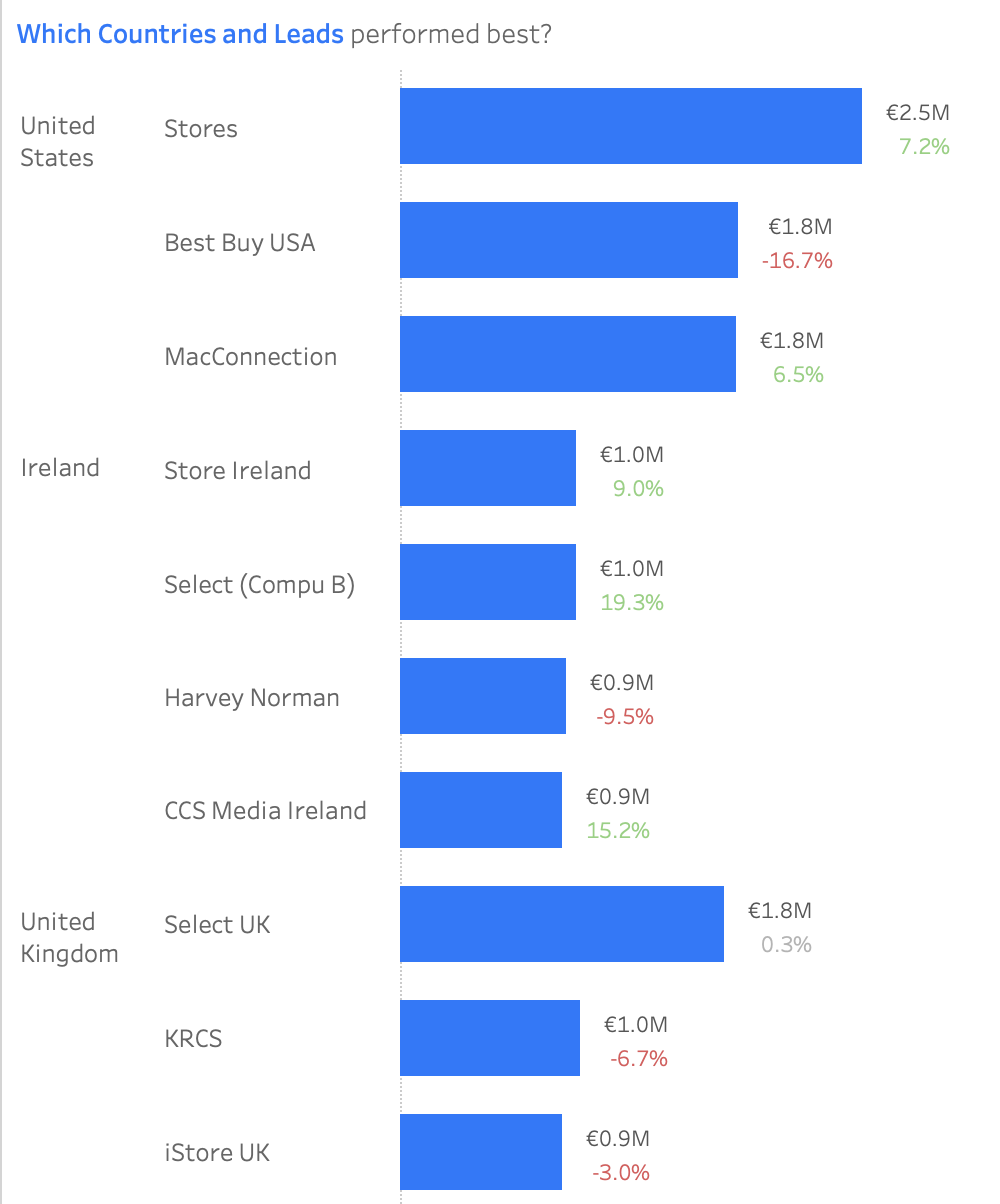
United States led with €6.2M in sales and US Stores leading with €2.5M in sales, while Netherlands grew 14%, and Canada declined by 12% since 2018/2019. Irish Store Select (Compu B) increased sales by 19.3%, which could be targeted for future sales leads.
Covid caused a -3.2% dip in 2020, followed by a +1.9% recovery in 2021, though sales hadn't fully rebounded.
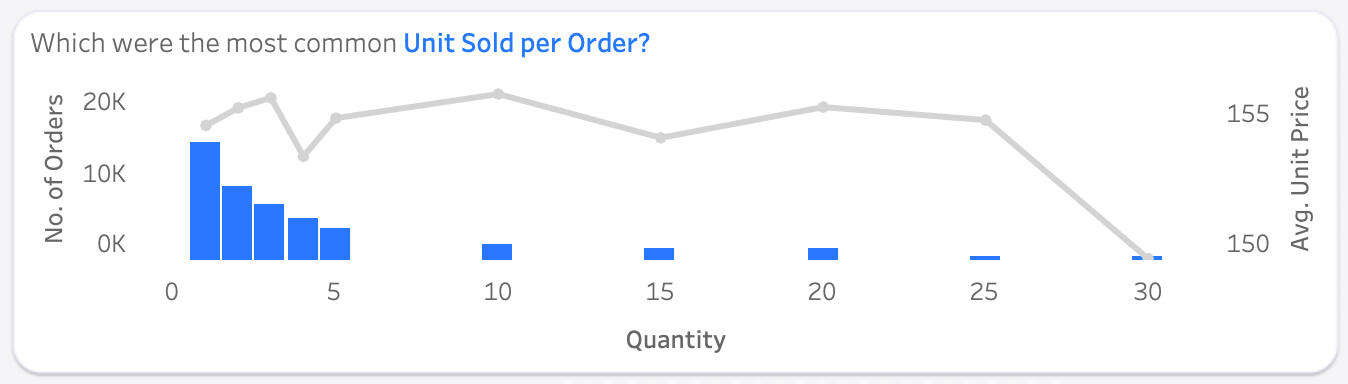
Customers tend to buy 1–5 products per transaction, but when making bulk purchases, they preferred 5, 10, 15, or even 30 items. This suggests an opportunity for special pricing on bulk purchases to encourage upselling.
December accounted for 77% of in-store sales, showing a strong opportunity for seasonal promotions. Shopping timing varied — females preferred Sundays and Mondays, while males leaned towards Thursdays for gift buying.
Two tabs answer the six questions. Slide between them — or tap either dashboard to zoom in.
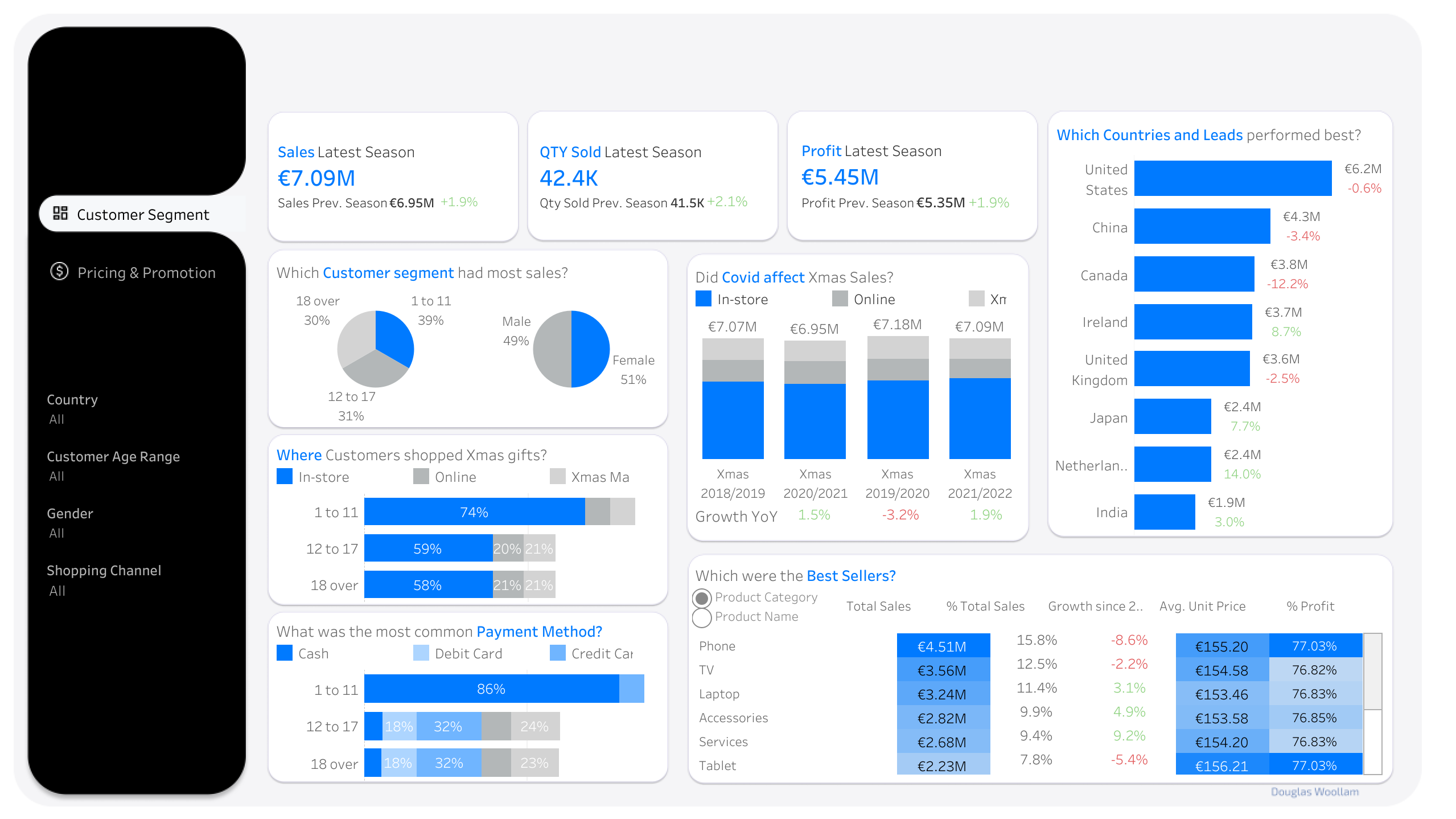
This tab helped answer the questions on Customer Segments, Best Performing Products, Geography, and Covid. It revealed that Children (ages 1–11) contributed nearly 40% of sales, highlighted the decline of top-performing products, mapped regional performance, and showed how sales dipped during the pandemic.
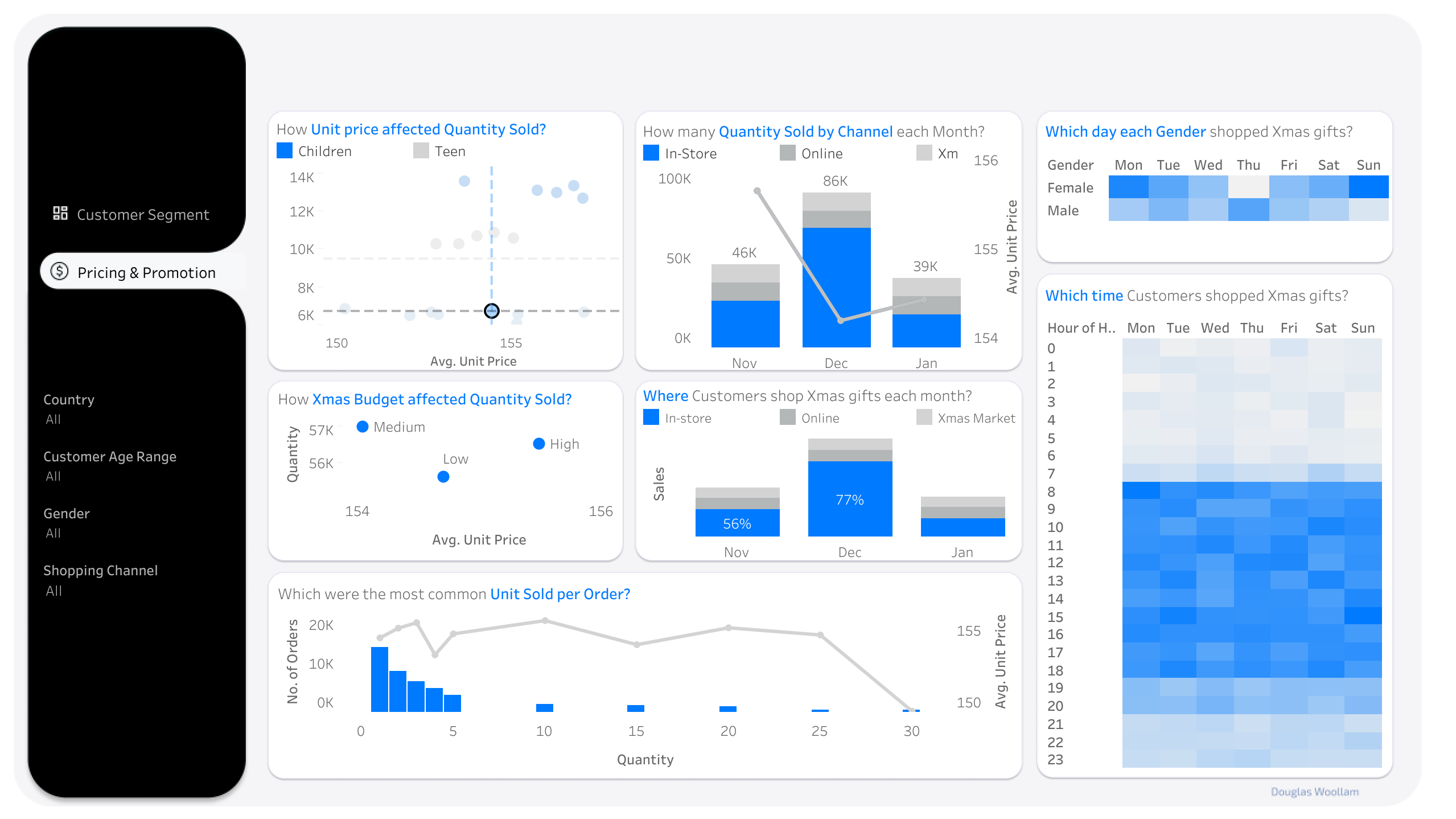
This tab helped answer the questions on Pricing and Shopping Timing. It analyzed how price variation affected sales, identified bulk promotion opportunities, and pinpointed December's 77% in-store sales share as the key window for promotions.
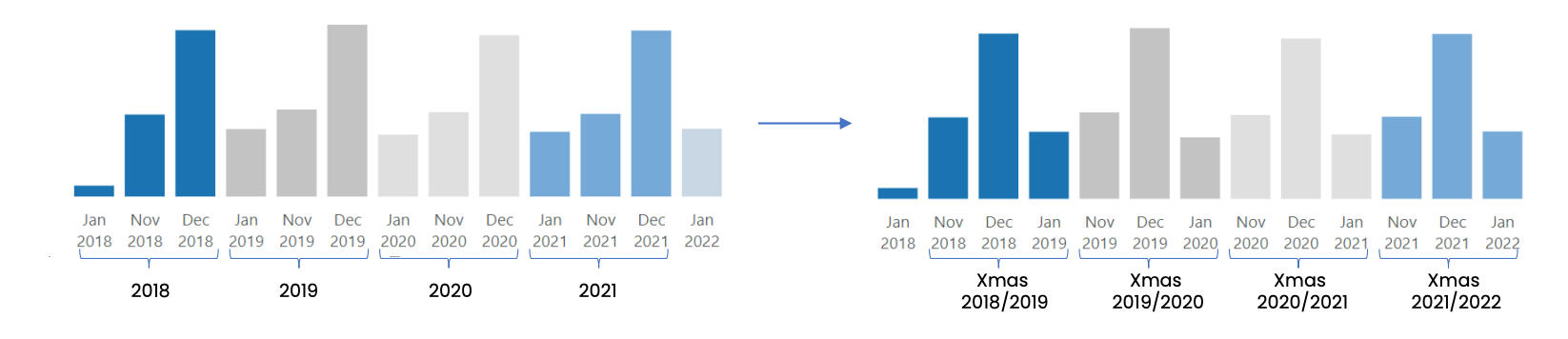
Instead of looking at the data by calendar year, data was grouped into Christmas Seasons to get a better understanding. For example, November 2018, December 2018, and January 2019 are combined into Xmas 2018/2019, considering these three months as one season for retailers and shoppers alike.
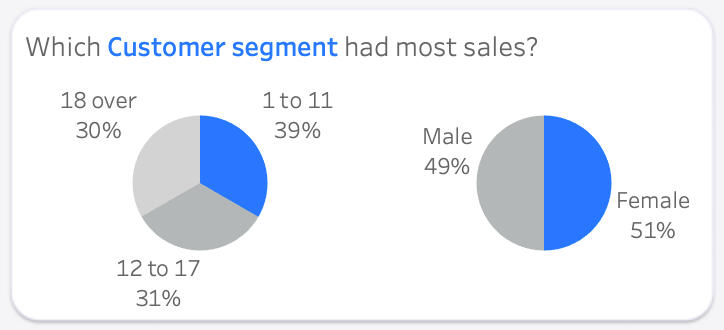
The Children segment (ages 1-11) stood out, contributing nearly 40% of total Christmas sales over the years. Interestingly, there was no significant difference between male and female customers across different age groups.
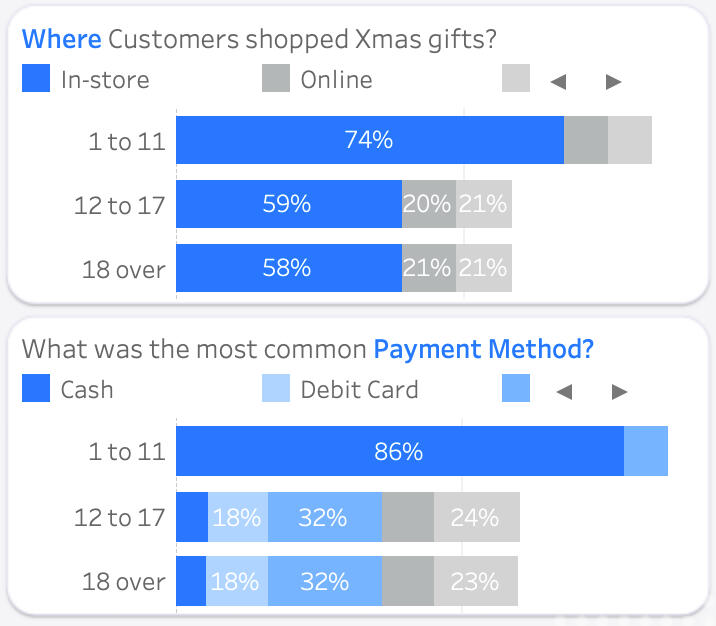
In-store shopping, particularly for the Children segment (74% in stores), was a prevalent choice. This is understandable as kids often prefer the hands-on experience of selecting gifts. Cash was the preferred payment method for Kid purchases, while Teens (ages 12–17) and Adults (ages 18 and over) leaned towards credit card, and cash was their least preferred payment method.
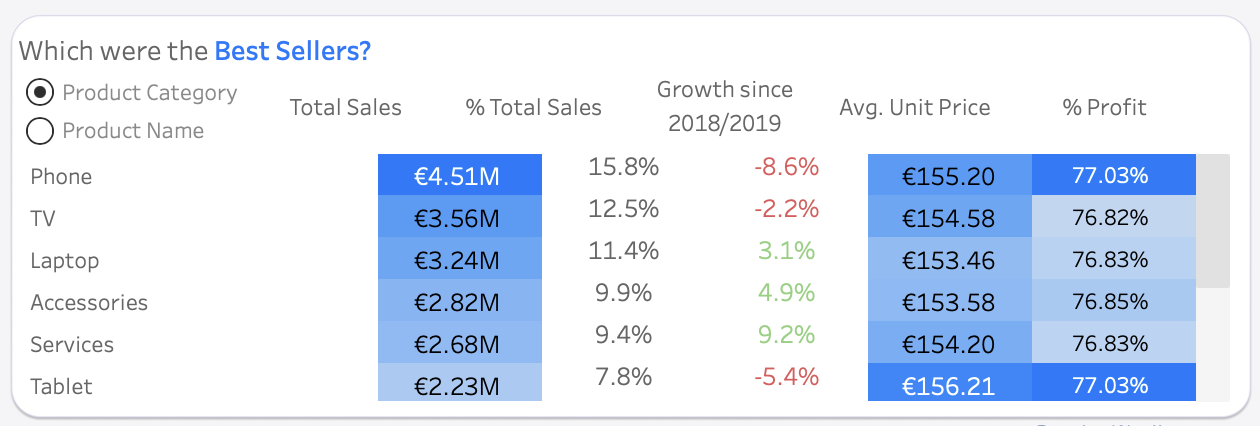
Overall, Phone and TV took the lead as the top-selling product categories, contributing a significant 27% to total sales among the 11 categories. While Phone stole the spotlight as the most beloved and profitable category with a staggering 77.03%, it's important to note that its sales had seen a notable decline in the past couple of years.
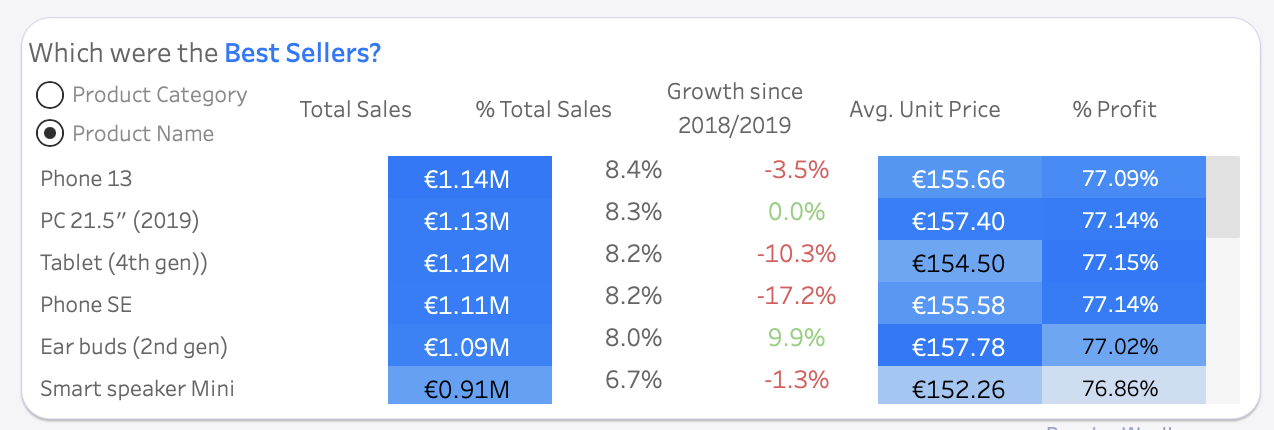
Breaking it down to the product level, Phone 13 and Phone SE were the best sellers, making up 8.4% and 8.2% of overall sales, respectively. Interestingly, the top 5 performers were all targeted at the Children segment. However, despite their initial popularity, all of these products saw a decline in sales, ranging from -2% to -15% over the past four seasons. Zooming in on the Teenager segment, Smart speaker Mini emerged as the most cherished Christmas gifts. Meanwhile, in the world of Adults, the Watch Series 5 stole the show, contributing the most to sales and enjoying a substantial sales growth of nearly 50% since the Christmas season of 2018/2019.
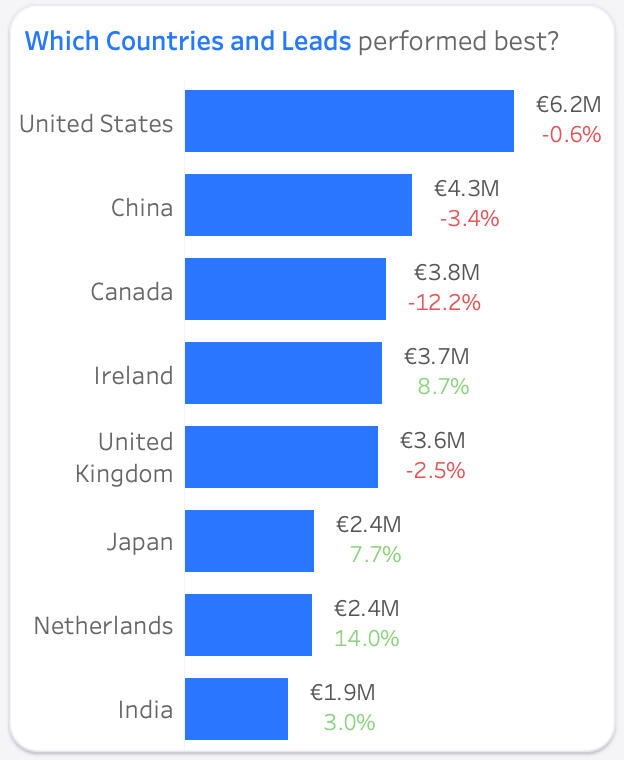
United States took the crown for the most Christmas sales over the four seasons, reaching €6.2 million. Canada, once the best in Xmas 2018/2019, faced a decline of -12% over the four seasons. The Netherlands showcased the most significant growth of 14%, climbing from the 7th to the 5th spot.
Drilling down to the Sales Leads, the three Stores in United States (Stores, Best Buy USA & MacConnection) emerged as the top-selling Stores, each generating over €1.8 million in sales. In Ireland, Store Ireland & Select (Compu B) emerged as the top-selling Stores, each generating over €0.9 million in sales.
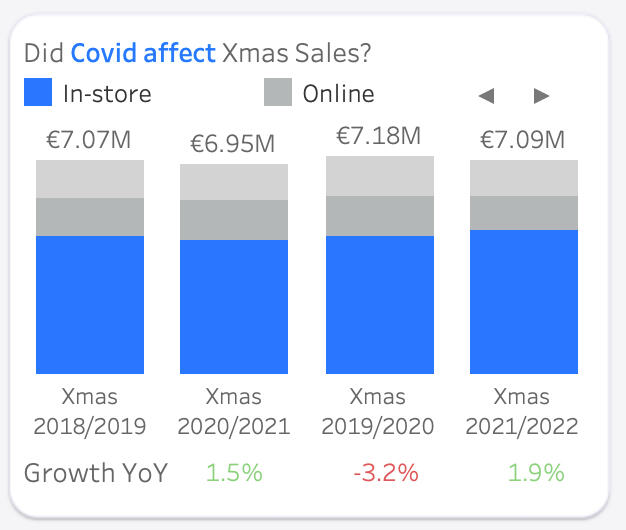
The Christmas gift market felt the impact of Covid in 2020, experiencing a -3.2% sales decrease. A recovery followed in 2021/2022 with a +1.9% increase, but the sales had not yet reached pre-Covid levels.
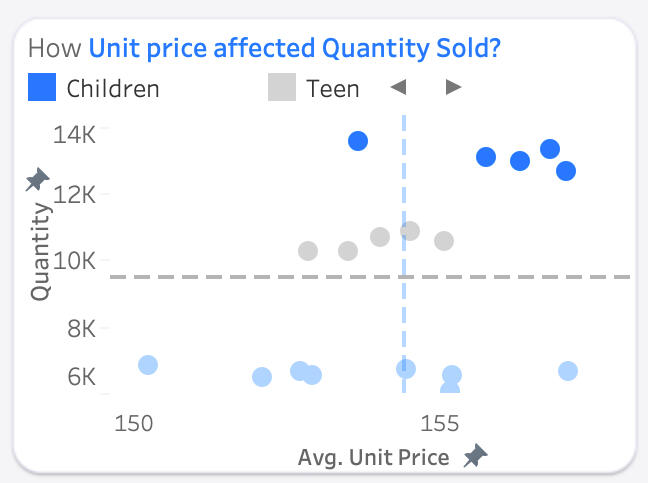
Despite higher prices, children's products lead in sales quantity, with over 12 thousand units sold for each product over the past four Christmas seasons. Among products for adults, unit price variation did not significantly affect the quantity sold (around 6–7 thousand units per product).
Customers tend to buy 1–5 products per transaction, but when making bulk purchases, they preferred 5, 10, 15, or even 30 items. This suggests an opportunity for special pricing on bulk purchases to encourage upselling.
December was the busiest month for Christmas gift shopping, with sales doubling compared to November and January. In-store shopping dominated December, accounting for 77% of sales, making it an excellent time for in-store promotions.
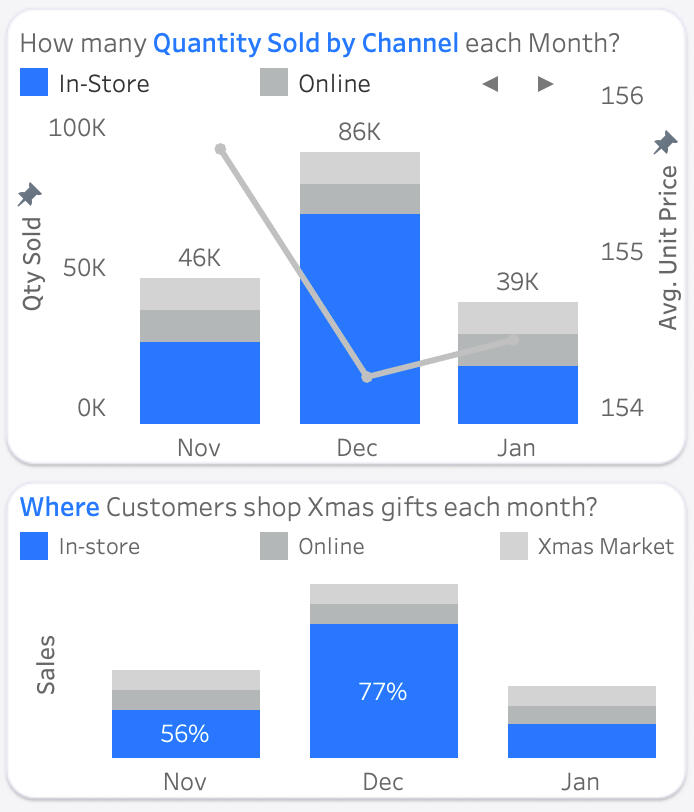
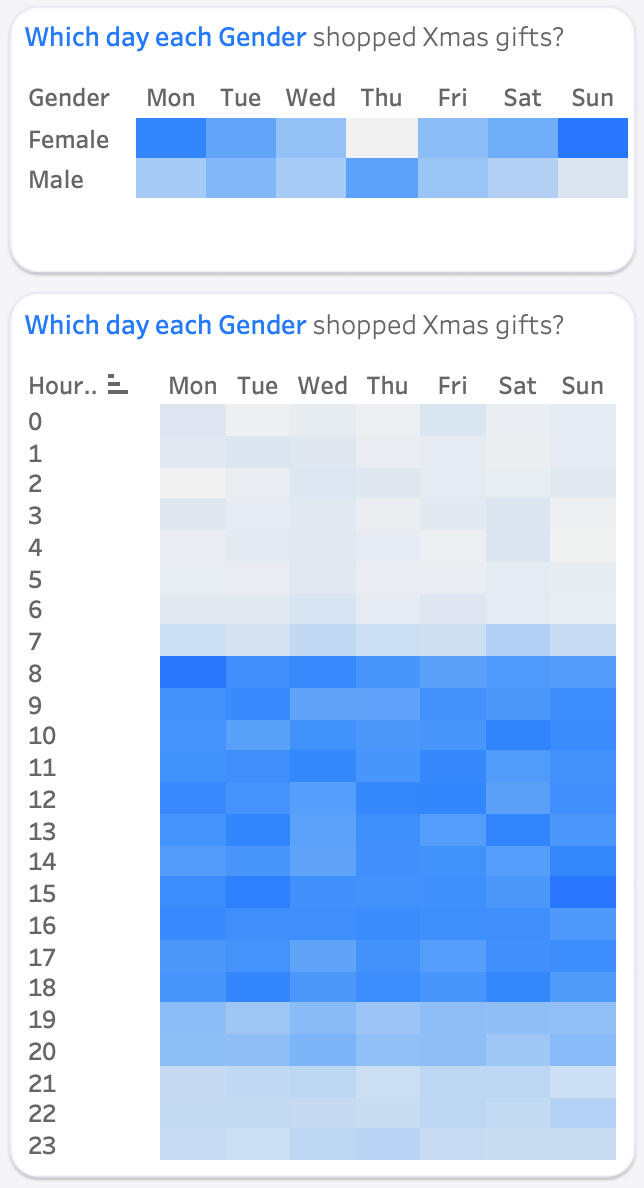
Shopping times varied across different channels. In-store shopping peaked on Monday, followed by Sunday. Sundays at 3 pm became the busiest time for Christmas markets. Online shopping provided flexibility, with peak times at Monday 8 am, Wednesday 11 pm, and Saturday 7 am. Weekday afternoons at 4 pm witnessed the highest online sales. While females preferred Sunday and Monday for Christmas shopping, males leaned towards Thursdays for their festive gift-buying spree.
Made for Mallow – Liscarroll Landscaping in my role as a Data Analyst. Recreated with artificial data.
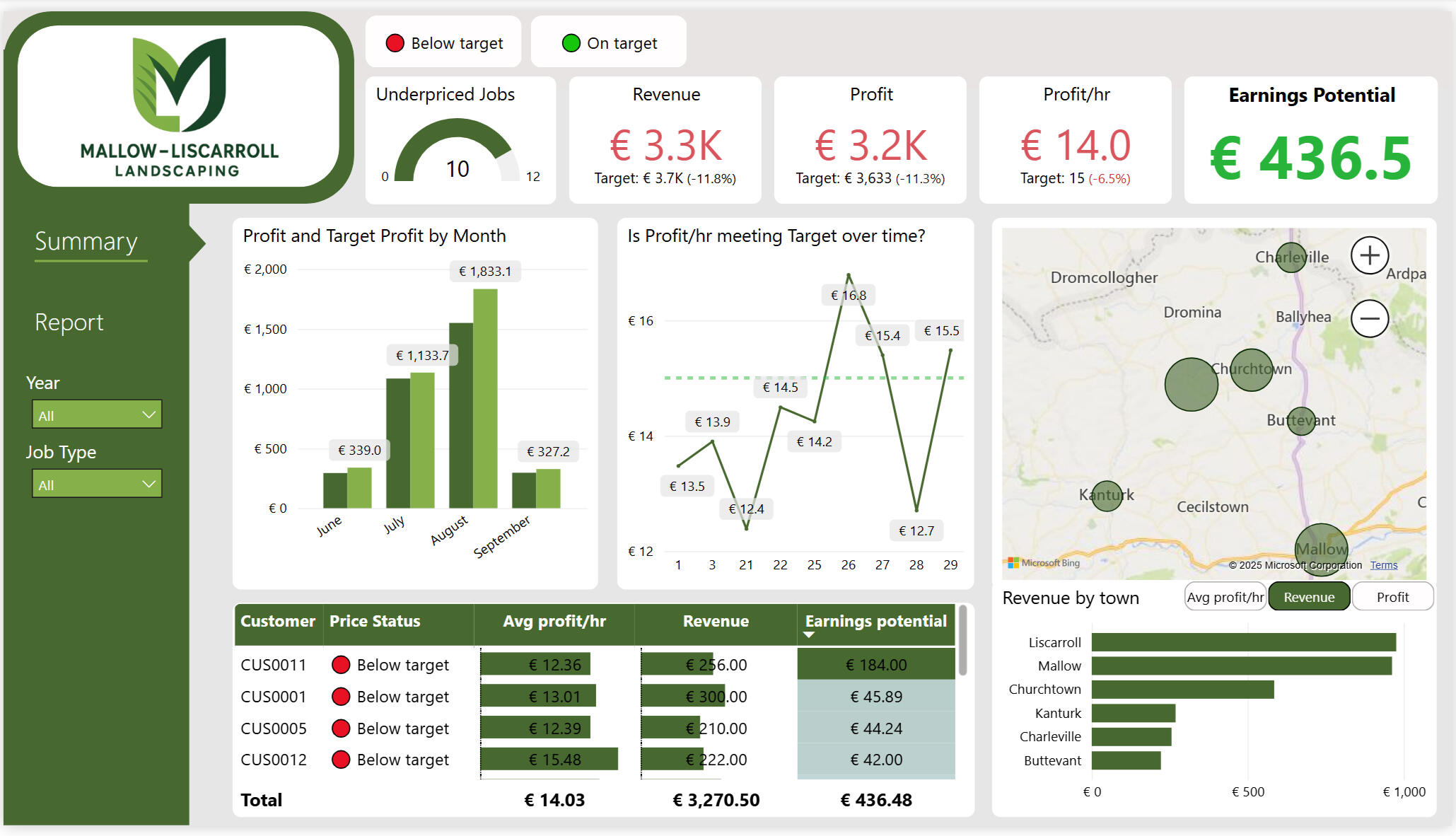
I built the BI stack for a landscaping business I co-founded — an SQL script and Power BI report that replaced manual processes. It increased profit by 20%, identified high-value towns to focus marketing and service checkups on, and saved 1.5 hours of reporting time every week.
Enhanced decision-making with DAX measures that blend distance, fuel price, rental gear and crew size into margin KPIs; visuals let the business slice profit by customer, townland, week or service at will.
Increased gross profit by 20% by developing DAX-based metrics for cost and profitability in a Power BI dashboard, identifying underpriced jobs, and presenting data-backed pricing recommendations to the business owner that included overlooked costs like fuel, distance and differing equipment.
Achieved an 85% repeat booking rate by tracking job frequency in Excel, automating maintenance reminders in Python, and optimising schedules to group nearby clients in Power BI, boosting recurring revenue, client satisfaction, and operational efficiency.
Enabled prioritisation of high-margin, efficiently scheduled jobs and reduced prep time by developing DAX-based KPIs in Power BI that provided cost breakdowns per job by time, location, proximity, and resource costs, improving decision-making and auto-generating daily equipment lists.
Cut weekly reporting time by 75% from 2 hours to 30 minutes by creating a user-friendly Excel workbook, automating the pipeline to the Power BI dashboard and ensuring smooth adoption with a comprehensive user guide and video walkthrough.
A single pipeline moves the data from a spreadsheet all the way through to an interactive report.
My Python code converted individual Excel pages into individual CSV files, ready to import into the Postgres SQL server.
# execute py file in jupyter_venv
from pathlib import Path
import pandas as pd

# path to the workbook
wb = Path('Mallow - Liscarroll Landscaping/landscaping_schema.xlsx')

# check the file exists before proceeding
if not wb.exists():
    raise FileNotFoundError(wb)

# iterate through every sheet
for sheet in pd.ExcelFile(wb).sheet_names:
    df = pd.read_excel(wb, sheet_name=sheet, engine="openpyxl")
    csv_path = wb.parent / f"{sheet.lower()}.csv"
    df.to_csv(csv_path, index=False)
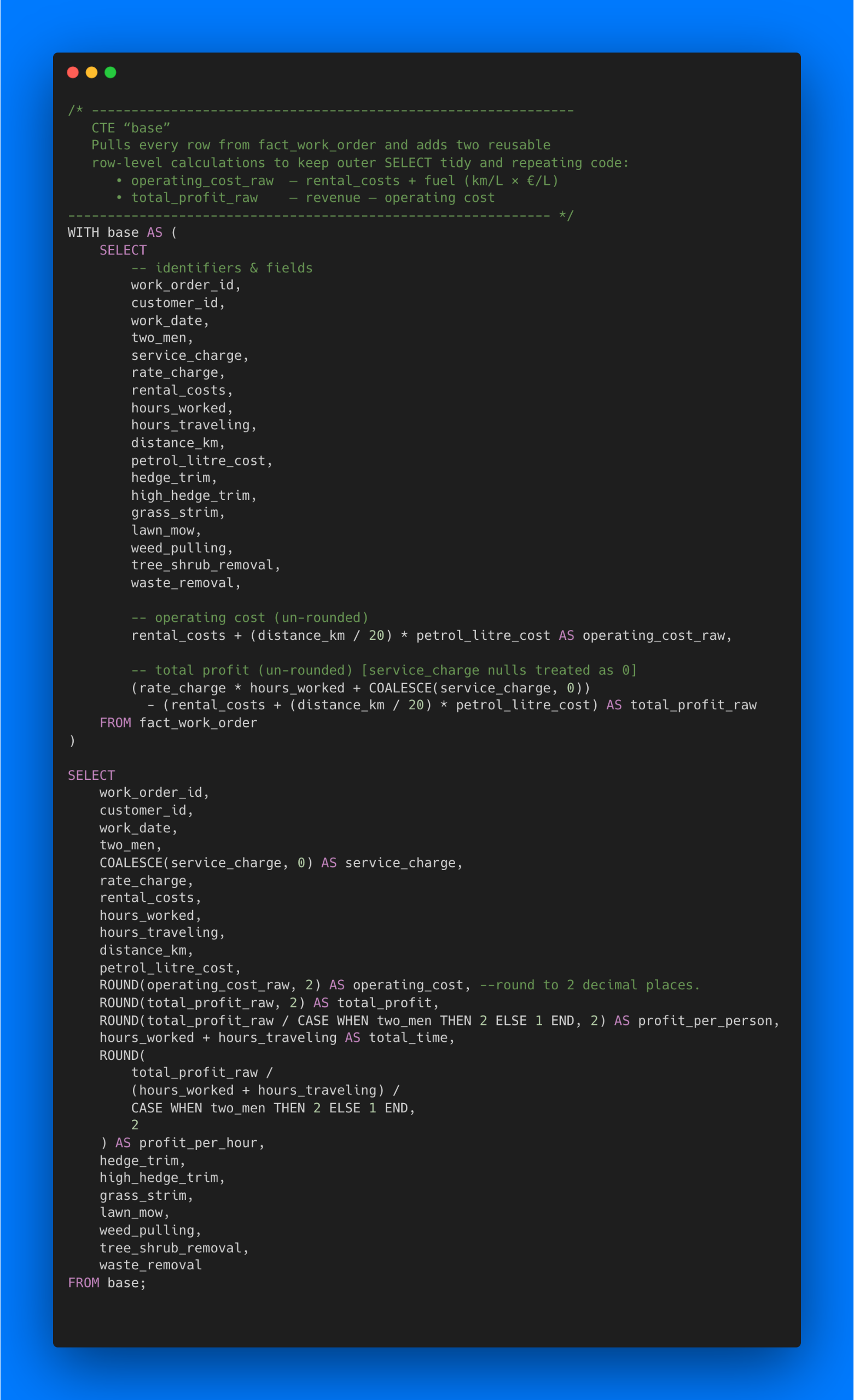
print("Exported", csv_path)170-line SQL script used to build tables from the CSV files. Defines keys and data types, NULL / empty value handling. CTE for dashboard metrics.
Below is the base CTE on fact_work_order, normalises service_charge nulls to 0, rounds to two decimals, and outputs dashboard metrics: operating_cost, total_profit, profit_per_person, total_time, and profit_per_hour
Two tabs make up the report. Slide between them — or tap either dashboard to zoom in.
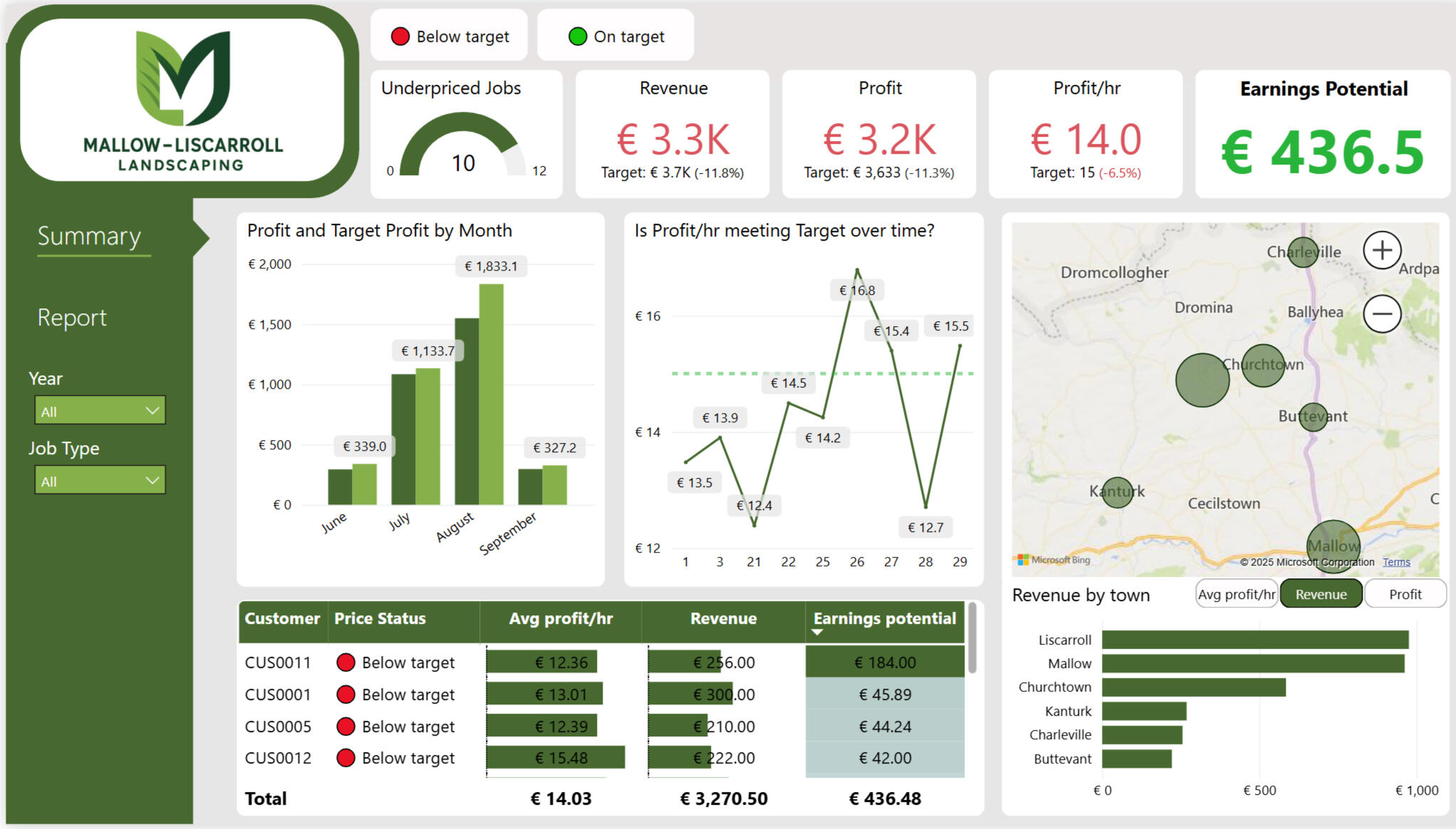
Includes slicers for below / on-target jobs, year and job type. The map and revenue-by-town bar chart use a field parameter to toggle between revenue, profit or profit/hr for flagging high-value towns. The column and line charts can be drilled up or down for time-series analysis.
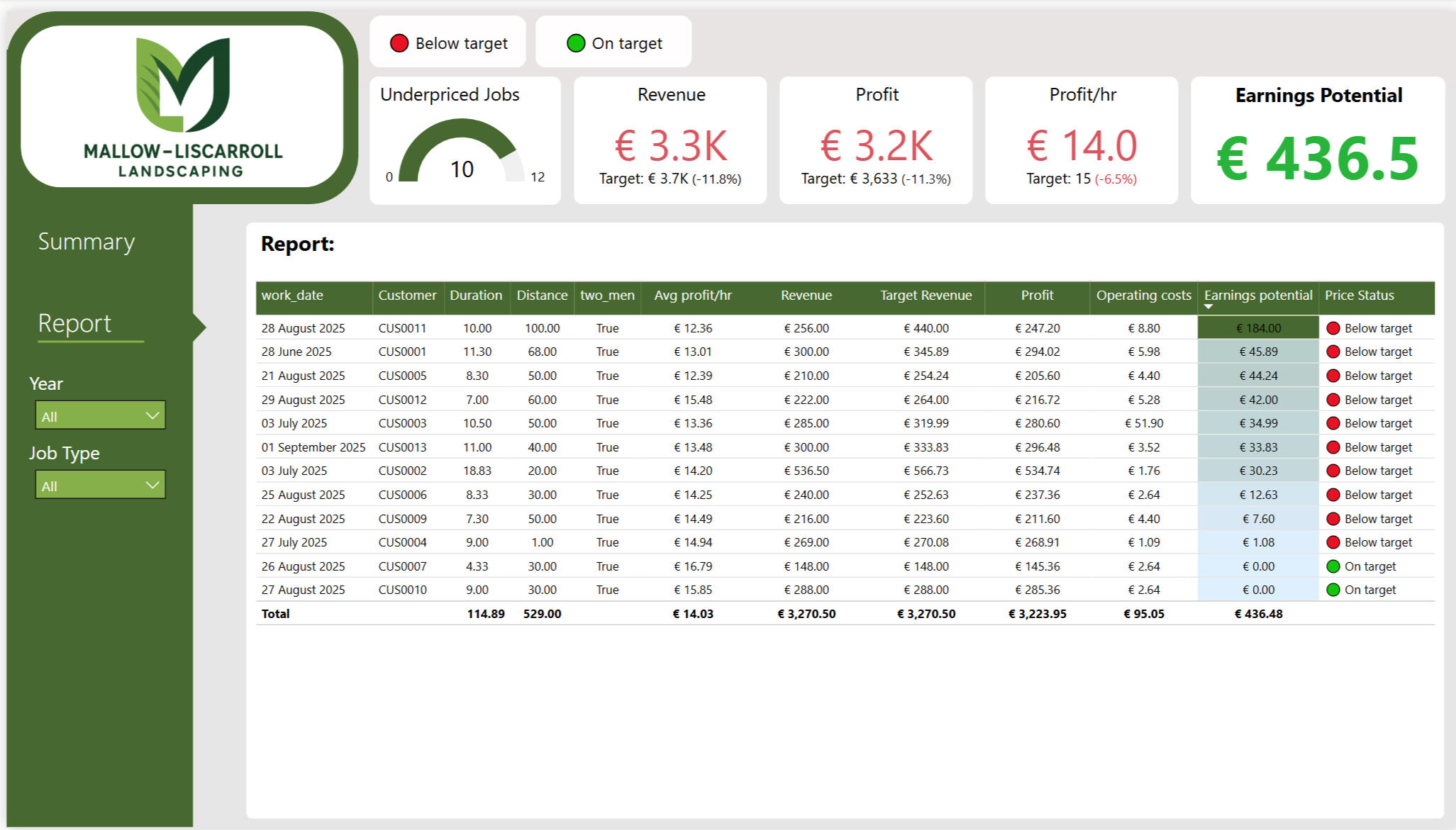
Presents a job-level table with key metrics: work date, customer, duration, distance, crew size, revenue, profit, profit per hour, operating costs, target revenue, earnings potential and price status. All slicers are synced with the summary page.
18 DAX measures were created across both tabs of the dashboard. Here are three of the core ones.
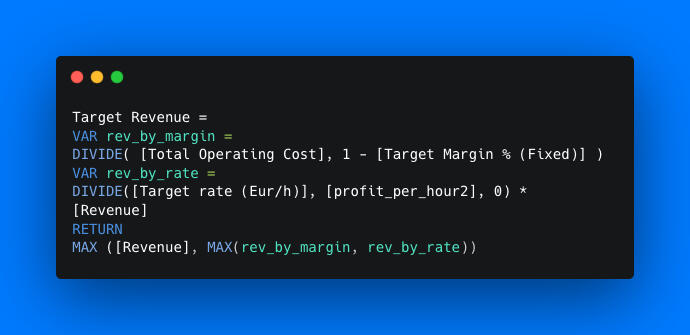
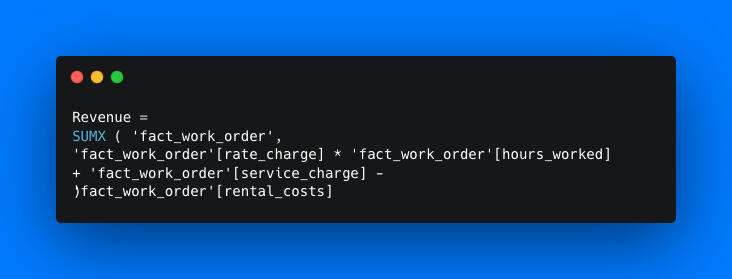
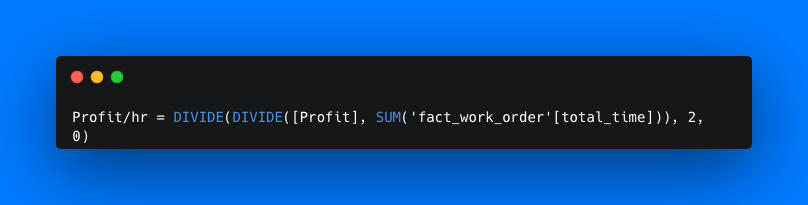
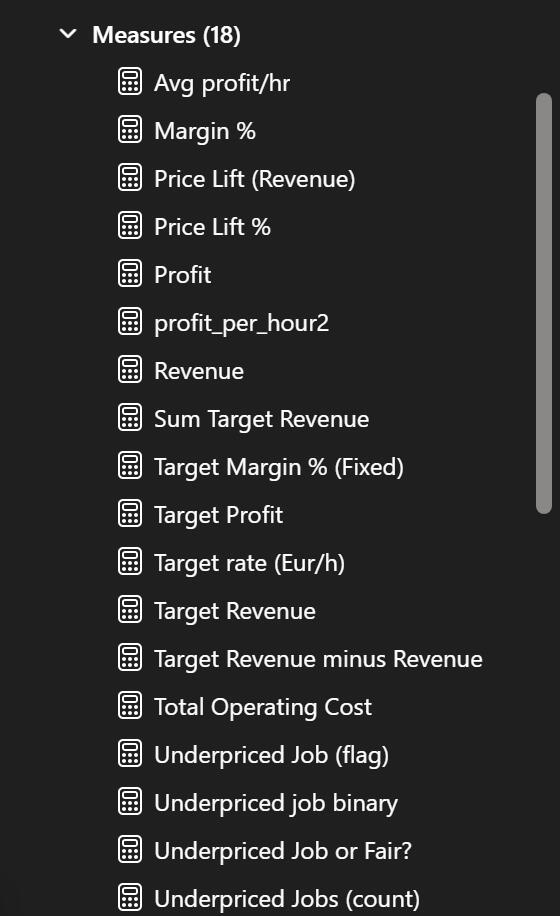
Overall, this project demonstrates how a data pipeline built with Microsoft Excel → Python → SQL → Power BI can transform raw operational data into actionable insights that increase profit, identify high-value clients, and support smarter business decisions.
Built for Cork AI Consulting to show how we report web and campaign performance. Created with example data.

Hover, filter and switch tabs.
Most owners we meet have Google Analytics switched on and never open it. The numbers are there, but nothing in the interface tells them whether last month was good. So we built the report we would hand a client: one screen, four KPIs, every number compared to the month before, and a second tab that ranks the sources sending the traffic. It runs on example web-analytics data, so the figures below describe the demo, not a real client.
Here are the takeaways from the demo data
Better on all four headline KPIs: 20,031 sessions (+29.9%), session duration up to 1 min 8 s (+17.2%), time on page +4.4% and unique pageviews per session +10.3%. More visitors and more engaged visitors, not one at the cost of the other.
Organic search carried 45% of sessions and direct another 24%, while paid search bought 6% and display returned nine sessions in the month. Referral sends the least traffic but the most engaged, at 2.4 pageviews a session.
No. Desktop is 77.3% of sessions at an 18% bounce rate; mobile is 20.3% and bounces at 27%. Mobile is also the fastest-growing slice, so the gap costs more every month it stays open.
Six referrers account for 19,885 sessions, and the top two — google.com.br at 44% and indiegogo.com at 24% — account for two-thirds on their own. The sparkline beside each one separates a steady stream from a single spike: cnet.com jumped 118.8% off a small base.
Traffic and attention do not line up. The busiest page holds a reader 22 seconds; the second-busiest holds them one second and bounces 29% of them. Two quieter pages hold visitors 36–40 seconds — the ones worth sending more traffic to.
Two tabs, built to be read in order. Slide between them — or tap either dashboard to zoom in.

The month on one screen. Four KPI cards across the top, then the five questions underneath: devices, referral sites, geography, channels and pages. Clicking the map filters the whole tab to one country.

The same four KPIs, each given a row: a 12-month trend with the average marked, and the top five source mediums ranked, with a reference line showing where each sat the month before.
Every number on the dashboard is a comparison, not a total. The header states the pair in plain English — showing results for Jan 2019 compared to Dec 2018 — and every KPI, bar and table inherits it, so nothing on the page can be read out of context.
Sessions reached 20,031, up 29.9% on the prior month, and the engagement measures rose with them: session duration +17.2%, time on page +4.4% and unique pageviews per session +10.3%. That combination matters. A traffic spike on its own usually means the new visitors are the wrong ones and every engagement metric sags; here they moved together, which points at better-qualified traffic rather than more of it.
Organic search brought 9,078 sessions (45%) and direct another 4,824 (24%) — nearly seven in ten visits arriving without being paid for. Paid search accounted for 6% and display for nine sessions in the whole month, which is the kind of line that ends a spend rather than starts an optimisation. Referral is the interesting one: the smallest of the meaningful channels at 10%, but the highest quality, at 2.4 unique pageviews a session against organic's 1.9 and direct's 1.4.
Desktop holds 77.3% of sessions and bounces at 18%. Mobile holds 20.3% and bounces at 27% — half again as often. Mobile sessions grew 12.3% in the month, so the weaker experience is the one gaining share. On a real site this is the first thing we would act on, because it is a fix to the site rather than a fix to the marketing.
Six referrers account for 19,885 sessions, and the top two carry two-thirds of them: google.com.br at 8,817 (44%) and indiegogo.com at 4,824 (24%). The sparkline beside each source is there to answer the follow-up question a total cannot — is this a stream or a spike? cnet.com grew 118.8%, but from a base of a few hundred sessions, and its shape says campaign rather than habit. The Brazilian search traffic is the opposite: large, flat and dependable, and worth a look at whether the site actually speaks to those visitors.
Ranking pages by sessions alone hides the problem, so each row carries time on page and bounce rate beside the count. The top page takes 3,441 sessions and holds them 22 seconds at a 16% bounce. The second takes 1,665 and holds them one second, bouncing 29% — a page getting traffic it does nothing with. Further down, two pages hold visitors 36 and 40 seconds on a fraction of the traffic. Those are the pages to point the marketing at.
The point of a report like this is not the charts — it is that an owner can open it on a Monday morning and, inside a minute, know whether the month was good, which channel earned the credit and which page is wasting the traffic it gets. That is the standard we build client reporting to, whether it lands in Tableau, Power BI or a weekly email.